Peggy’s Cove Area Festival of the Arts Celebrates 10th Anniversary Festival

Making a welcome return to the summer line-up of wonderful activities in the Bay, The Peggy’s Cove Area Festival of the Arts (PCAFA) is back with three events in July. Two events, Paint Peggy’s Cove and the Studio Tour, are cherished cornerstones of the Festival, which started in 2010. The third event is new, a Members’ Exhibit at the Community Enterprise Centre.

With 100 member artists, PCAFA has reached a milestone of its most members ever, representing all ages, media, styles and area locations.

Here is more information on the three Festival events this year:

Paint Peggy’s Cove, July 10–12 (10 am–5 pm, Saturday and Sunday, 10 am–4 pm Monday)

A plein air event with over 40 artists creating new works at Peggy’s Cove. Works are on view and for sale the same day they are created. Visit 124 Peggy’s Cove Road in the village. A children’s art area offers free creative activities.

The Studio Tour, July 16 –18 (10 am–5 pm)

A showcase of the diverse works of over 70 local artists at more than 40 studios, community locations, and galleries. Chart your own free, self-guided tour and meet the artists. The tour is laid out online here: https://halifaxartmap.com/art-map/pcafa.

Stop One this year is the Community Enterprise Centre at 5229 St. Margaret’s Bay Road.

Members’ Art Exhibit, July 8–29 (hours vary, see below)

This show, at the St. Margaret’s Bay Community Enterprise Centre, 5229 St. Margaret’s Bay Road, offers works by 50 participating artists. Weekdays, 9 am–4 pm from July 8 to 29, 10 am–5 pm on July 10, 11, 17 and 18.

Throughout the Studio Tour weekend, visitors may enter their names in a draw for an art gift certificate worth $500.

For more information, visit www.peggyscoveareafestivalofthearts.com.

Image:  Gretchen Amirault, “Rockway Beach,” oil on canvas.

BayRides, Bay Seniors and CEC Provides an Afternoon Art and Jewellery Excursion

BayRides, the Community Enterprise Centre (CEC), and Bay Seniors are partners in a different kind of Friday happy hour in February, designed to lift the spirits of Bay residents who have difficulty getting out of the house and accessing the community.

BayRides is giving free rides to Bay residents who would appreciate an outing and don’t have access to a car. The funding for this comes from a grant from the Covid-19 Emergency Community Support Fund and United Way.

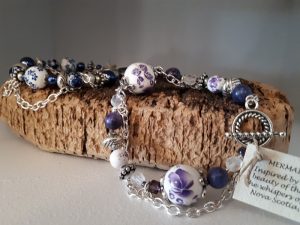
BayRides, Bay Seniors and the CEC are providing an afternoon excursion every Friday in February to bring up to 6 people to the CEC to see the Winter in the Bay art by Peggy’s Cove Area Festival of the Arts member artists and check out some of the Bay Seniors jewellery. A CEC receptionist and two Bay Seniors volunteers will host the visitors between 3 and 5.

Covid precautions are in place in the BayRides vehicle and at the CEC. To book a spot, call Lynn at BayRides at 902-820-6600. Please book at least 48 hours in advance.

Winter in the Bay Story Contest: Writing Tips from a Pro

by Neil Everton

Sometimes the empty page or the blank screen can paralyze us. So here’s some advice from that wonderful Newfoundland writer and now Halifax resident Donna Morrissey: “Don’t agonize about or over-think the process of writing. Just get started. Get the story out.”

Tell your story to the page. Trust your intuition. The polishing comes in the re-writing. The poet Robert Graves once said: “There’s no such thing as good writing. Only good re-writing.”

And that’s vital when you only have 350 words to play with.

But before you start writing or rewriting, slow down. Think about the advice of Winnie the Pooh: “Organization is what you do before you do it, so when you do it, it’s not all messed up.”

Stare out of the window. Daydream. Bounce ideas around your brain. What do you want to achieve? What’s your purpose, and what style would suit that purpose?

Give yourself a framework on which to build your story. Make sure there’s a logical flow to the way you reveal information. Everyone talks about a beginning, a middle and an end. Here’s a variation that really helps me: hook, context, unfolding, wrap.

Thinking about a hook helps me focus on snagging the audience’s attention quickly. In our short-attention-span world, if you don’t grab them early, you may not get them at all.

Then comes context. It’s the need-to-know information that prepares us for the rest of the story. Keep it short. Too much of a history lesson can slow down your storytelling.

The unfolding is where the story blossoms. We really get to know the character and the setting, and delve into the character’s motivation and concerns. And this is where you need a dollop of magic sauce.

The magic sauce is conflict. The best stories are explorations of conflict. Not necessarily in the sense of a knock-down-drag-out fight. More likely in the overcoming of everyday obstacles. It’s the overcoming of obstacles that brings a story to life and engages your audience.

The wrap is where you pull all the threads together. 

Now it’s time to write. Remember, the inspiration for your essay comes from a painting or quilt. But you don’t have to write about or describe the particular piece. Let it be the spark for your creativity. The story you want to tell may not perfectly fit with one of the pieces. That’s okay.

Show, don’t tell. Let your audience discover for themselves something about your subject. It could be in a quote, or a memory, or in the way you capture the passion of your character for a person or place. Specifics are always better than generalities for bringing a character or a setting to life.

Write for all the senses. Sometimes we focus on what we can see. Go further than that. What are the smells or the sounds that will paint an unforgettable picture of your character or location?

When you start to polish, strip every sentence down to its barest bones. Every word that is not working hard for you is getting in the way. Imagine you have to pay $1 for every word. Pretty soon you’ll start stripping out words that are not earning their keep.

Fall in love with the delete key. Start with adjectives and adverbs. Follow Mark Twain’s advice: “When you catch an adjective, kill it. No, I don’t mean utterly, but kill most of them—then the rest will be valuable.”

Verbs are your writing muscle. Strong active verbs push the writing along. Weak, passive constructions slow you down like a tired five year-old in a supermarket. Don’t settle for the first verb that pops into your mind. Find the verb that energizes your writing. Beefing up a verb can be much more effective than reaching for an adverb.

Any writer who has sold 350 million books is worth listening to. So let’s get some advice from the king of horror, Stephen King: “One of the really bad things you can do to your writing is to dress up the vocabulary, looking for long words because you’re maybe a little bit ashamed of your short ones. This is like dressing up a household pet in evening clothes. The pet is embarrassed and the person who committed this act of premeditated cuteness should be even more embarrassed.”

So keep it simple. If you found yourself floundering in the ocean at Queensland Beach, you wouldn’t yell “Your assistance is required due to my imperilled state.” If the single word ‘help’ is all you need, don’t dress it up.

Find your voice. Listen to how you talk to your family, or your friends. Try to capture that energy and that style in your writing. Be who you are, not who you think you should be.

Study the writers you admire. Read poetry. Good popular music is a great place to refine your writing skills. Good songs convey the maximum meaning with the minimum words. There’s no room for clutter. So if books on grammar don’t turn your crank, put on some music or listen to poetry.

Finally, don’t worry too much about the grammar police. Worry about making us feel something more than about splitting an infinitive.

About the author: Neil Everton started writing for a weekly newspaper at age 18 in an English coal-mining town. That led to a daily newspaper, and then to the BBC where he worked on news and documentaries. As assignment to the Middle East to cover the first Gulf War led to a meeting with CBC producer Halina St James, marriage and relocation to Nova Scotia. Since then he’s worked with Reuters, CBC, CTV and Global. 

Writing Examples with Illustrating Works from the Winter in the Bay Art Show

Do you have a real-life story you’d like to share? Are you a writer or aspiring writer who wants to try your hand writing fiction? Do you appreciate the chance to enjoy works by local artists?

Winter in the Bay is a new community program celebrating creativity—and winter—with an art and quilt exhibit, followed by a writing contest. The program is a partnership between the St. Margaret’s Bay Community Enterprise Centre, The Peggy’s Cove Area Festival of the Arts, the Seniors Association of St. Margaret’s Bay, The Masthead News, the Halifax Public Libraries, Tantallon, and the St. Margaret’s Bay Chamber of Commerce.

Thank you to Linda Mosher and Mary Lynn Mackay for offering this wonderful example of how writers are asked to use a work from the Winter in the Bay Art and Quilt Exhibit to inspire and/or illustrate their essays and stories. Linda’s story “Feeding a Family in the Depression” and Mary Lynn’s painting “Frozen Lake” were created independently, but together they help to tell a wonderful story of a cold winter adventure nearly a century ago in St. Margaret’s Bay.


Winter in the Bay: Feeding the family during the Great Depression
Linda Mosher

During the Great Depression, my grandfather could not find work. Suddenly, it was an icy winter without money, and barely enough food to feed the family.

One morning, my grandmother went to the cellar for butter, finding that a rat had tunnelled through the block.  She cut that part off, considering herself lucky to salvage the rest.  

My grandfather was desperate to get some fresh meat for his family, and arranged for two friends to go deer-hunting with him.  Delayed by a big snowstorm,they set out early one morning, and were gone so long that my grandmother was worried sick.  They finally returned in late afternoon without a deer, saying they had shot a huge moose. The three men couldn’t carry the moose out, so decided to come home, get warm, eat a hot meal, and then take their wives and my grandmother’s sister back to help with the moose.  My grandmother remembered it as a beautiful night, with a bright, full moon and millions of stars shining in the heavens.  During the day, the snow had hardened, and it glistened in the moonlight. They were all in a good mood as they tied ropes around the moose and pulled it along like a toboggan over the hard snow.  

The next morning, the men got together and cut up the meat. They shared it around with thankful family and neighbours.  

A couple of days later a game warden knocked on their door. He was investigating a complaint they had shot a moose out of season. My grandfather invited the game warden in, and had a nice long chat with him while my grandmother served the warden a hot meal with moose meat.  My grandfather told the warden that his family and neighbours were starving, and they had shot the moose and shared it around the village so everyone could have fresh meat on their table.  

The game warden thanked them for their hospitality, leaving with a smile on his face and a neatly wrapped package of moose meat tucked tightly under his arm.

Bay Businesses and Artists Creatively Helping Customers Buy Local

Small businesses, artists and artisans are struggling this year, with events and shows being cancelled, and stores having reduced hours and traffic capacity.

One example is the cancelled Red Roof Artists’ show and sale, scheduled for November 28 and 29 at the Community Enterprise Centre. The artists and the venue were unanimous that cancelling was the responsible decision in light of Covid concerns, but missing holiday season sales is a disappointment.

While there’s never been a more important time to shop locally to support businesses and artists, with a responsibility to stay home as much as possible, many of us are shopping more online. When a local business or artist has a website with sales options, we can shop online and still shop local.

When a business or artist we want to support doesn’t have a website, Keith Ayling, Bay Chamber of Commerce president, says we can often still buy from them. Keith says we should call the business or see if they have a Facebook or Instagram account where we can contact them for shopping options. “Many businesses have turned to creative solutions to serve their customers, including curbside pick-up, contact-free meeting and even delivery,” says Keith. “The first and most important step is to reach out to the business and ask.”

The same goes for artists and artisans. The Red Roof Artists, for example, have been sharing their contact information as a scanning code (and as a document, for those without the scanning technology, see link below), so people can still find them. It doesn’t replace the traffic offered by a show, but it helps motivated buyers to connect.

And for that, say the local artists, they are truly grateful.

Red Roof Artists Contact Details

Bay Kids Asked to Make Cards to Add to Bay Seniors Christmas Gift Bags

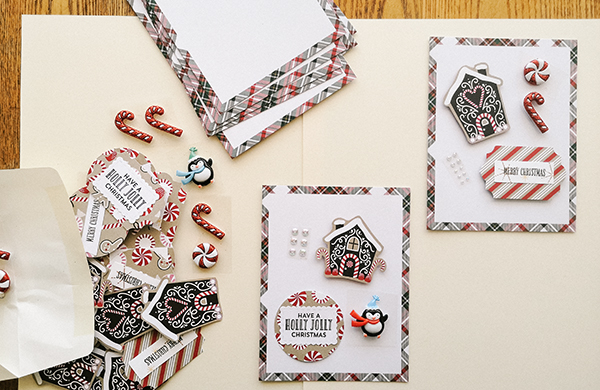
The Bay Seniors Association is inviting local children and teens to assemble and personalize Christmas cards for local seniors.  The cards will be included with the Christmas gift bags the association is putting together for around 75 local seniors.

Volunteer-created card kits, with a card, envelope and several decorative components, can be picked up from the Community Enterprise Centre (CEC) at 5229 St. Margaret’s Bay Road, currently offering front-door pickup and drop-off Monday, Wednesday and Friday, 10 a.m. to noon. Kids are encouraged to assemble and personalize the cards as they wish, adding a holiday greeting. Completed cards should be dropped off at the CEC by December 15.

Rebecca Weickert, president of Bay Seniors, says this is the second time the association has offered this program. “We did it near the start of Covid, and it was a lovely way for families to reach out to seniors. We’ve had many comments from seniors who received one, saying how much it meant to them to get a cheerful card with a caring message from a local child or teen. And the kids had fun opening the kits and using them as a starting point for their own creativity.”

The Christmas in the Bay organizers are also promoting the program, and Weickert says Bay Seniors is delighted to have that help to ensure more families participate. “We will definitely send out all the cards we receive. This is an especially important Christmas for us all to stay in touch and let our neighbours know we’re thinking of them,” she adds.

Michelle MacLean, the Bay Seniors board member who is coordinating the Christmas gift bags, says the association is grateful to the community members who have been donating items to fill the 75 Bay Seniors volunteer-made fabric tote bags being used for the gifts. “We’ve had a wonderful response, with people dropping off puzzle books, socks, pens, eyeglass cleaner, facial tissues, and lots of other goodies. But, says MacLean, “We have room for more,” especially what she calls “the basics,” like boxes (not purse packs) of facial tissue, small bottles of hand sanitizer and puzzle books and pencils.

MacLean says gift bag items can be dropped off at the CEC until December 7.

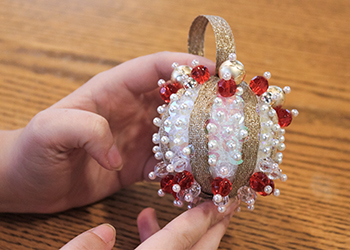
Christmas in the Bay How To Series: Transform Costume Jewellery into Ornaments

Instructions from Bay Seniors and co-op student Mellisa Larson
This is an activity that requires adult supervision for children under age 10 to 12 because it requires using pins or a hot glue gun.

What you’ll need:
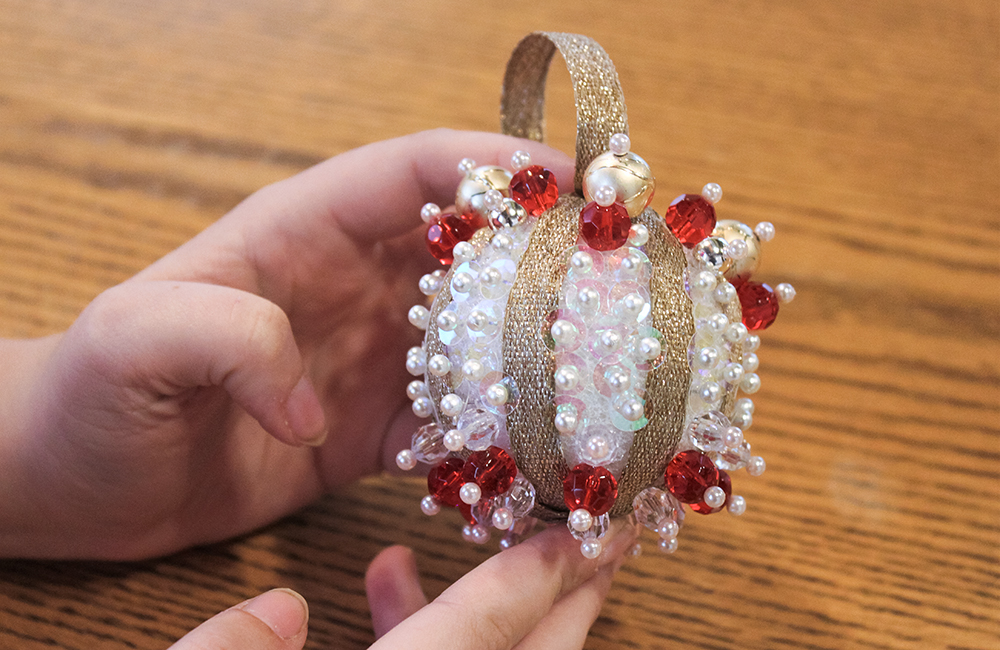
A styrofoam ball, available from craft stores. Good ornament sizes range from about 2 inches to 4 inches in diameter. Smaller than that, and they’re hard to work with; larger than that, and they take too many beads and may be too large for most trees.
Plastic, metal, glass or faux pearl beads from necklaces or bracelets.
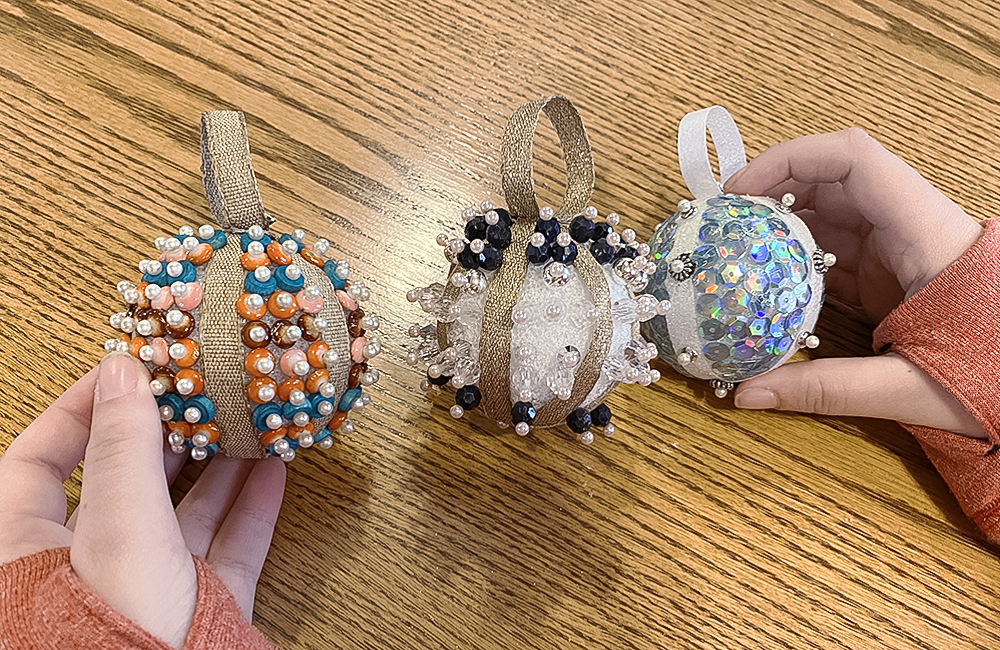
Ribbon to make a loop to hang the ornament. Extra ribbon if you want to use it to section the ornament (see photos).
Sequin pins or glass-headed pins or hot glue gun. Craft glue doesn’t work well with some bead types, and if you want to use the ornament over many years, pins work best.
Craft sequins. These fill in spots, add sparkle, and help create a nice pattern.
A plate or tray to hold beads so they don’t roll away.

How to make the ornament:
1. First, and most important, make sure whoever owns the jewellery gave you permission to use it for an ornament!

2. Strings of beads, either colourful or shiny, make great ornaments. Faux pearls are very pretty, too, but are often individually tied, which is the traditional stringing method with cultured and natural pearls, too. So it can take a long time to pull those necklaces apart.

3. Round beads work best, though irregular shapes can be fun, too. They’re just harder to place uniformly on the foam ball.

4. See how many beads you have and design your pattern based on that. For example, if you have crystals from a bracelet, you may want to space those out around the ornament, or have one even ring of crystals around the top, bottom or centre of the ornament. The good thing about using pins rather than hot glue is that you can move things around!

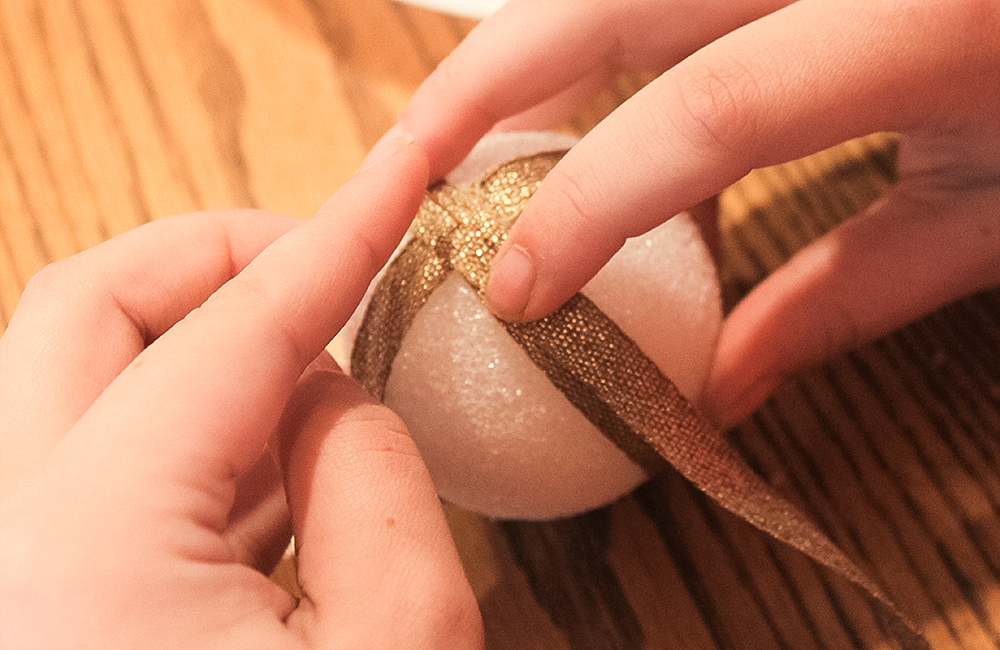
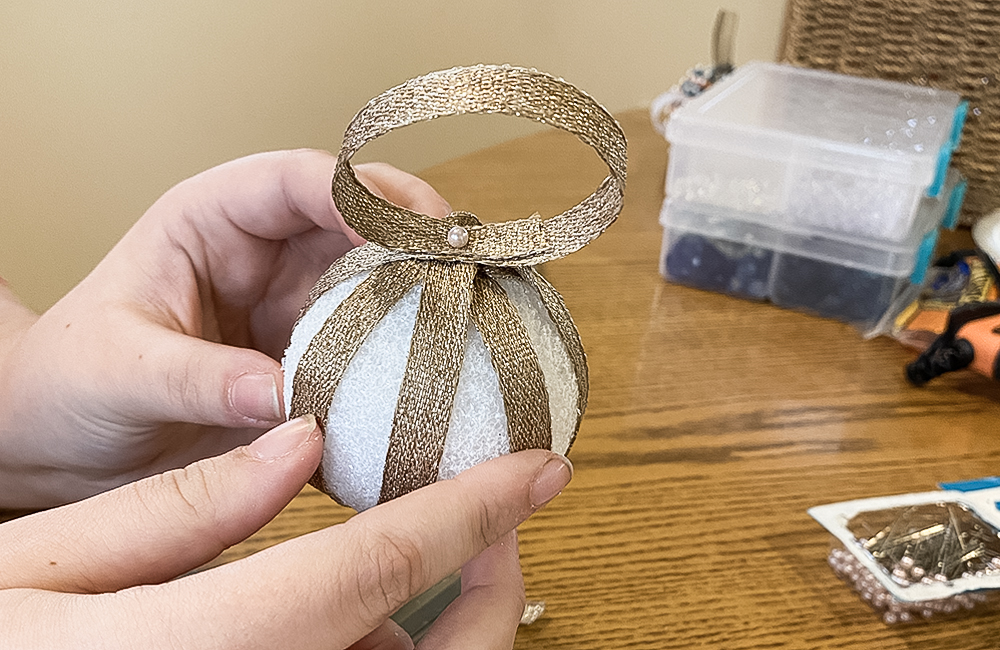
5. Decide whether you want to go around the foam ball once with the ribbon, or several times. If once, cut enough of one piece of ribbon to go around the ball from bottom to top, allowing an extra 4 inches to fold over to make a loop (see photo). Pin ribbon in place at bottom centre of ornament and then at top, folding over the hanging loop first.

6. If you want to add more ribbon, put another length of ribbon just around the ball (see photo). Depending on the size of the foam ball and the width of the ribbon, you may want one, two or three lengths of ribbon. You will only need one length to be long enough to form the loop.
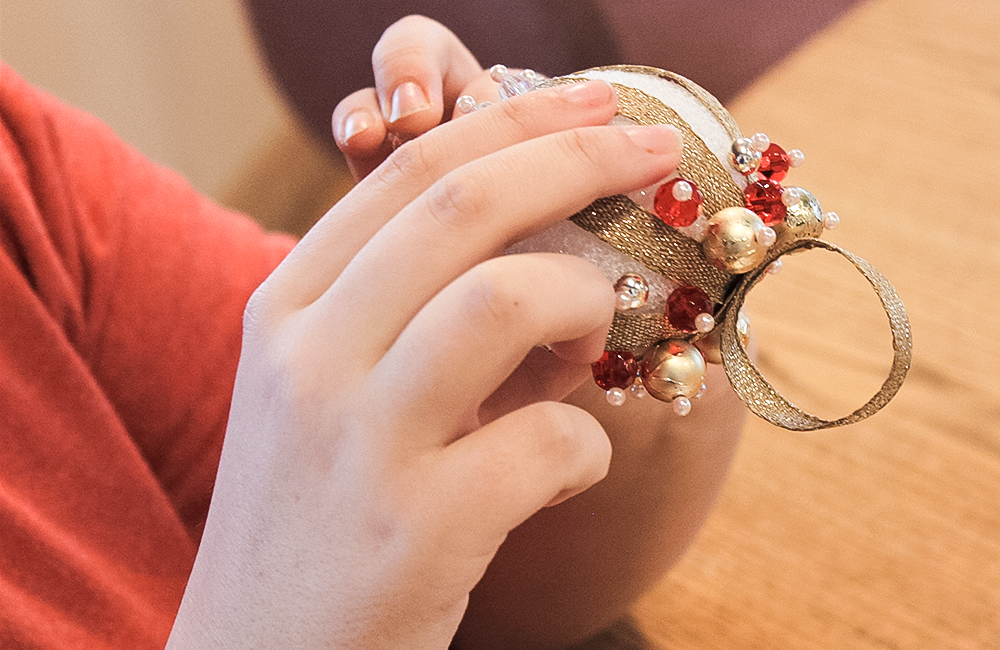
 7. Start to fill in the empty spots between the ribbon. You can have an orderly pattern, a free-form abstract pattern, or something in-between. It’s your choice!
 8. Place your beads from the jewellery first. If using pins, push the pin through the hole in the bead until the head of the pin is stopped by the size of the bead opening.
 

9. Place your sequins next to fill in any other spots.

10. You have an ornament! Handle costume-jewellery ornaments carefully, preferably storing them in their own container (a yogurt or sour cream container works well) when they are not on display.

Fun tip: Consider asking a friend or family member for old costume jewellery they no longer wear, including the story or a photo of when they did wear the jewellery. Ensure they know the jewellery will be used in a craft activity! Make an ornament out of the costume jewellery, and give the ornament to them as a gift, with the story and/or photo included in a card you’ve made and decorated yourself.

Video tutorial: